When the 2017 Venice Biennale first opened, countless art blogs and writers were quick to offer their opinions and critiques. Knowing that many visitors would only spend a few days in the city, these insiders published countless articles on the must-see pavilions and exhibitions at the Biennale. If you have a limited amount of time, they say, here are the pavilions you have to see. Prior to coming to Venice, I have to admit I was one of the many tourists who hungrily searched these articles. For the most part, these lists were the same. Everyone advertised the German pavilion, the winner of the Golden Lion, the American, Russian, and so forth. One list, however, advertised the Lebanese Pavilion. I was fascinated and quickly added it to my list of must see pavilions.
As soon as we got to Venice, I was determined to find the Lebanese Pavilion. As many other blog posts have described, the Venice Biennale is divided between two main sites with national pavilions and affiliated exhibitions scattered throughout the city. After four failed attempts, I discovered that to get to the Lebanese Pavilion, you had to take a vaporetto from the Arsenale to an adjacent location. So I did eventually find it, but not without a lot of frustration and some angry German yelling.
Entitled the Temple of SamaS, the Lebanese Pavilion features the work of artist Zad Moutaka. Located within the space of the former military Arsenale, the piece pays homage to the to SamaS who, according to the Code of Hammurabi, was the Babylonian god of the sun and justice. The pavilion is large and dark and so there is someone at the door to guide you into the space. Within the space is a multi-media installation that draws from sound
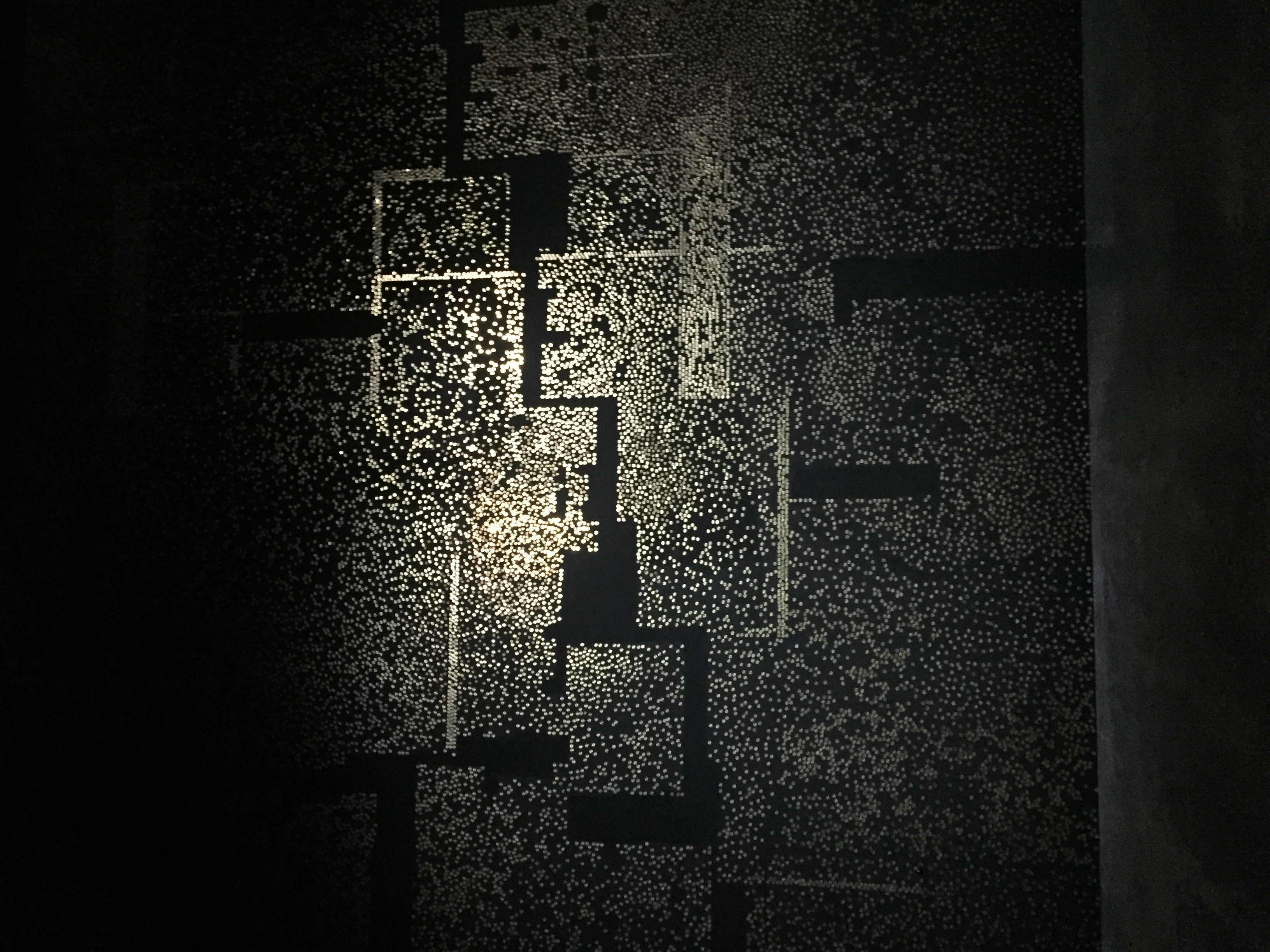
and light. A series of stand-alone speakers line the right and left walls and voices emerge that chant the story of SamaS through The Hymn to SamaS. On the far wall opposite the entrance Lebanese coins create a pattern on the wall representing the Golden Calf. As the the chanters move through the hymn, various portions of the wall are lit up until a slowed down track of a fighter plane interrupts the singing. The wall and room are completely illuminated as the sound of the plane erupts from the space. At this point, lights turn to the the center sculpture which is revealed to be a Bomber jet engine and a child’s voice emerges and chants the Lamentation for the ruin of Ur.
I was fascinated by this pavilion and watched the installation from various angles, moving in and out of the space to read the didactic to try to make sense of it all. As I left the space, I was stopped by the attendant who had guided me into the pavilion. After asking if I spoke Italian, she transitioned to English and held out a coin very similar to the ones on the wall. She explained that they gave a coin to every visitor who stayed for the duration of the installation or longer. Since I had stayed for more time, I would be gifted this coin which was a symbol of good luck.
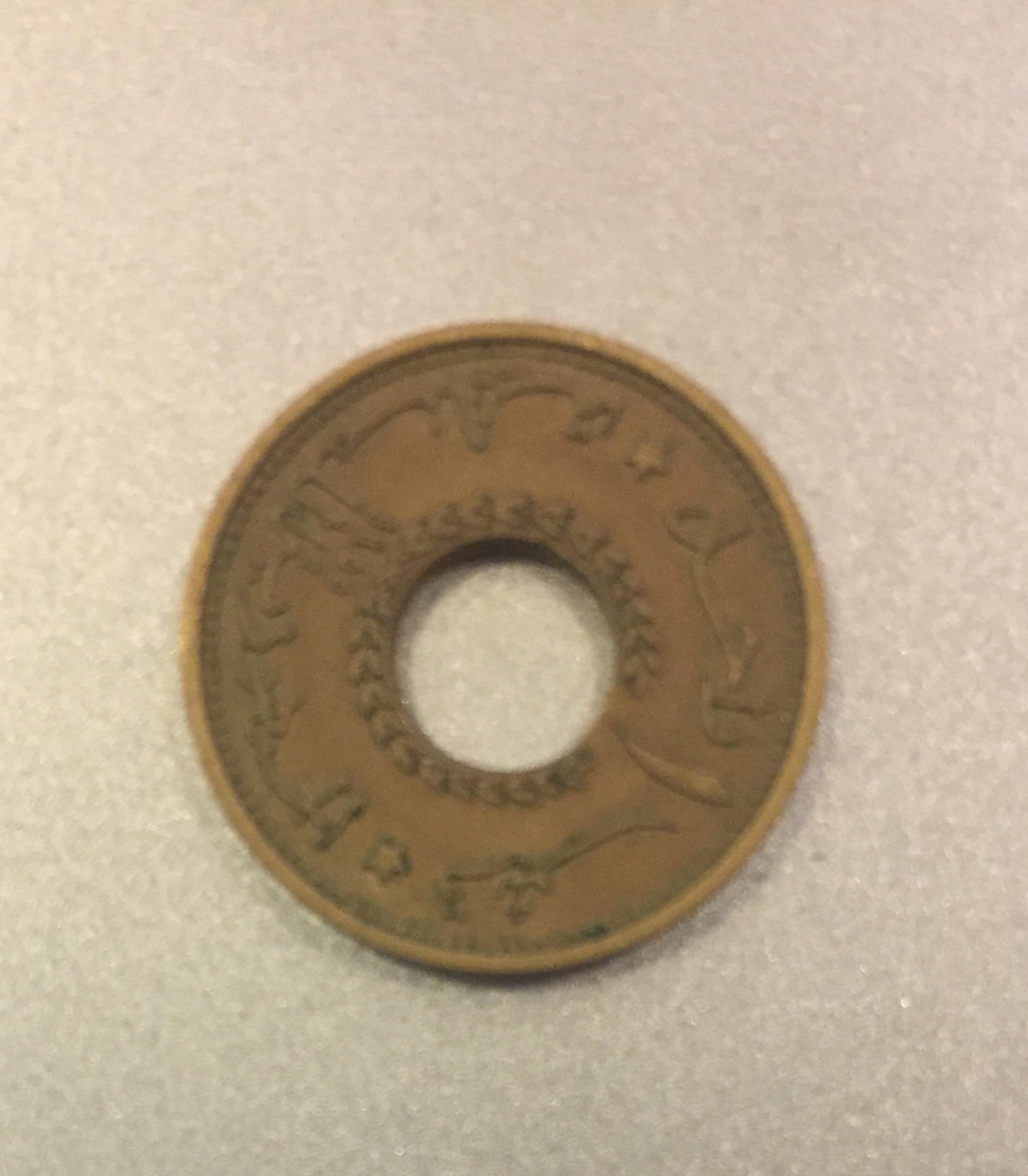
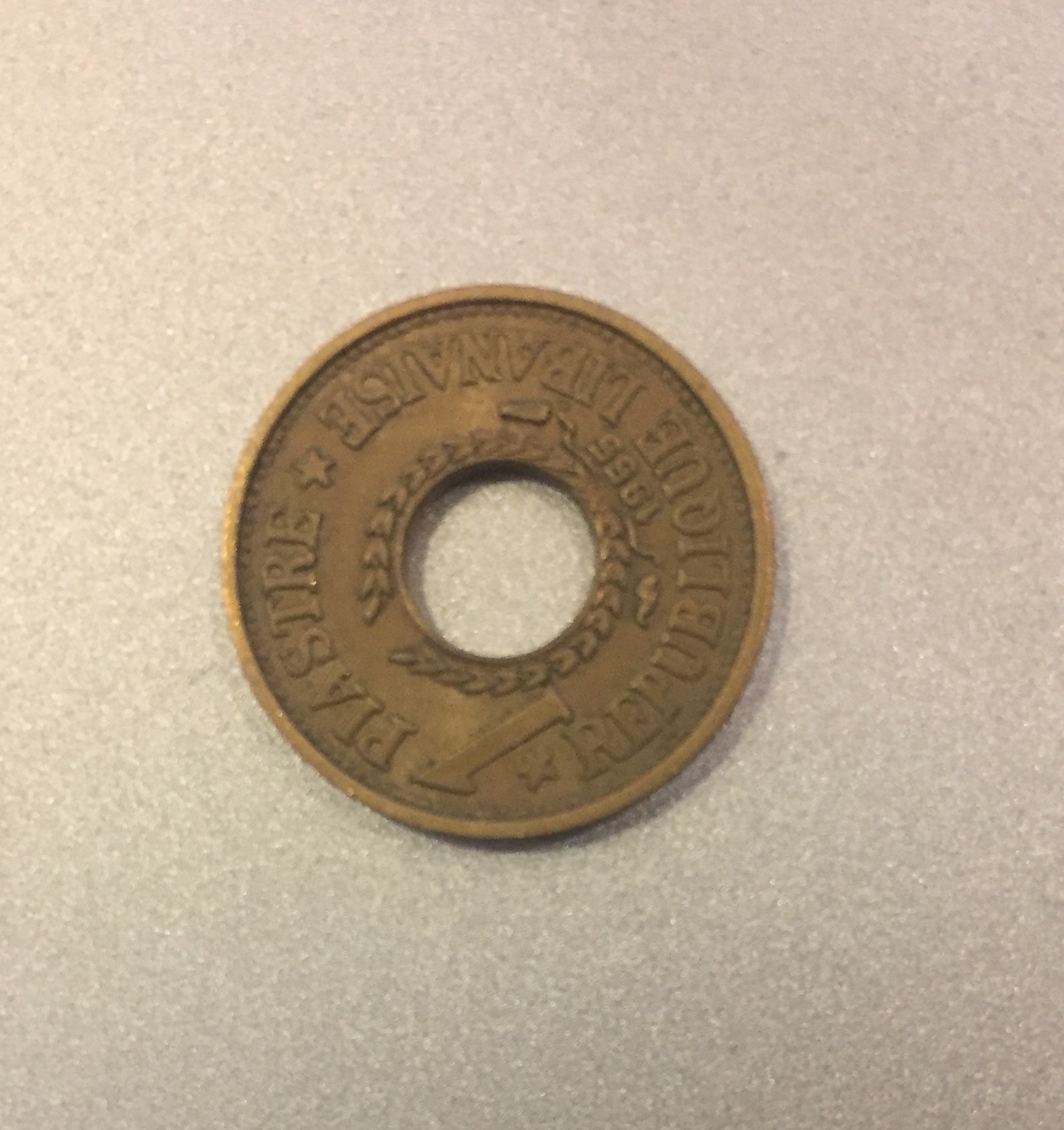
I was completely taken aback and even a little in shock. Checking my watch, I realized I had spent close to 45 minutes in the pavilion. This was a typical amount of time to spend in a pavilion and nothing compared our two-hour long marathon in the German and the South African pavilions. Given that the pavilion was hidden and had to be reached by boat, I wondered how many coins she had given out. How many people had taken the time to seek out the pavilion? I had been so taken by the installation itself and the gratitude offered by the pavilion attendant, that I felt frustrated by the lack of attention to the pavilion. The pavilions in the Giardini are grand, beautifully designed, and filled with years of historical memory. That being said, not all nations are able to have these historical pavilions in the Giardini. Others are confined to singular, exhibition-like rooms in the Arsenale or are positioned far away from the eyes of the visitor. What if the Lebanese pavilion had been a long-standing building in the Giardini like that of the American, Russian, French, or German? Or even what if they had the same budget as these other countries? If this had been the case, maybe the Lebanese Pavilion would have been on all must-see lists and could have been in contention for the Golden Lion.
Grazie. You looked and found it. Thanks for telling about your trek. Nice idea about the coin.
Julia, I am glad you finally found the Lebanese pavilion even after failing so many times! I wish I had that much determination, but it turned out to be very worth your while. When I first saw the Lebanese pavilion I was taken aback by how dark it was on the inside and it took a while for my eyes to adjust. It was not until the end of the sound performance did I really see the array of coins on the back wall. I am glad you were able to witness this exquisite work! I was also given a coin for staying at the pavilion for long and it was also a shock. It seems as if I was taking a bit of the art with me, as if to never forget the great beauty of this pavilion. I also saw it as a way to advertise a pavilion that took so much effort to reach. Imagining if the Lebanese pavilion would have the same affect as it did so far away is something I pondered over for awhile. I think that whether the pavilion was far or near to the main Giardini, it made me feel as though I found a hidden gem amongst other mundane pavilions. I am happy we had very similar experiences.