In response to the global art world’s elitism, the criteria of accessibility is becoming increasingly discussed in regards to contemporary artistic production. Art works confronting the barriers that hinder individuals and communities from experiencing or appreciating art, such as socio-economic class, level of education and geographic location, are prioritized in a globalizing world that values transnational and communal experiences. This appreciation of the approachable is demonstrated by the “trendiness” of Relational Aesthetics– an artistic practice acting as a catalyst for human interface that has developed over the past couple of decades, and which often involves different forms of viewer participation. Viewer participation with works of art can often break down the haughtiness and impenetrability associated with the art world. Erwin Wurm is one artist whose works are often qualified as accessible because of their basis in viewer participation and performance.
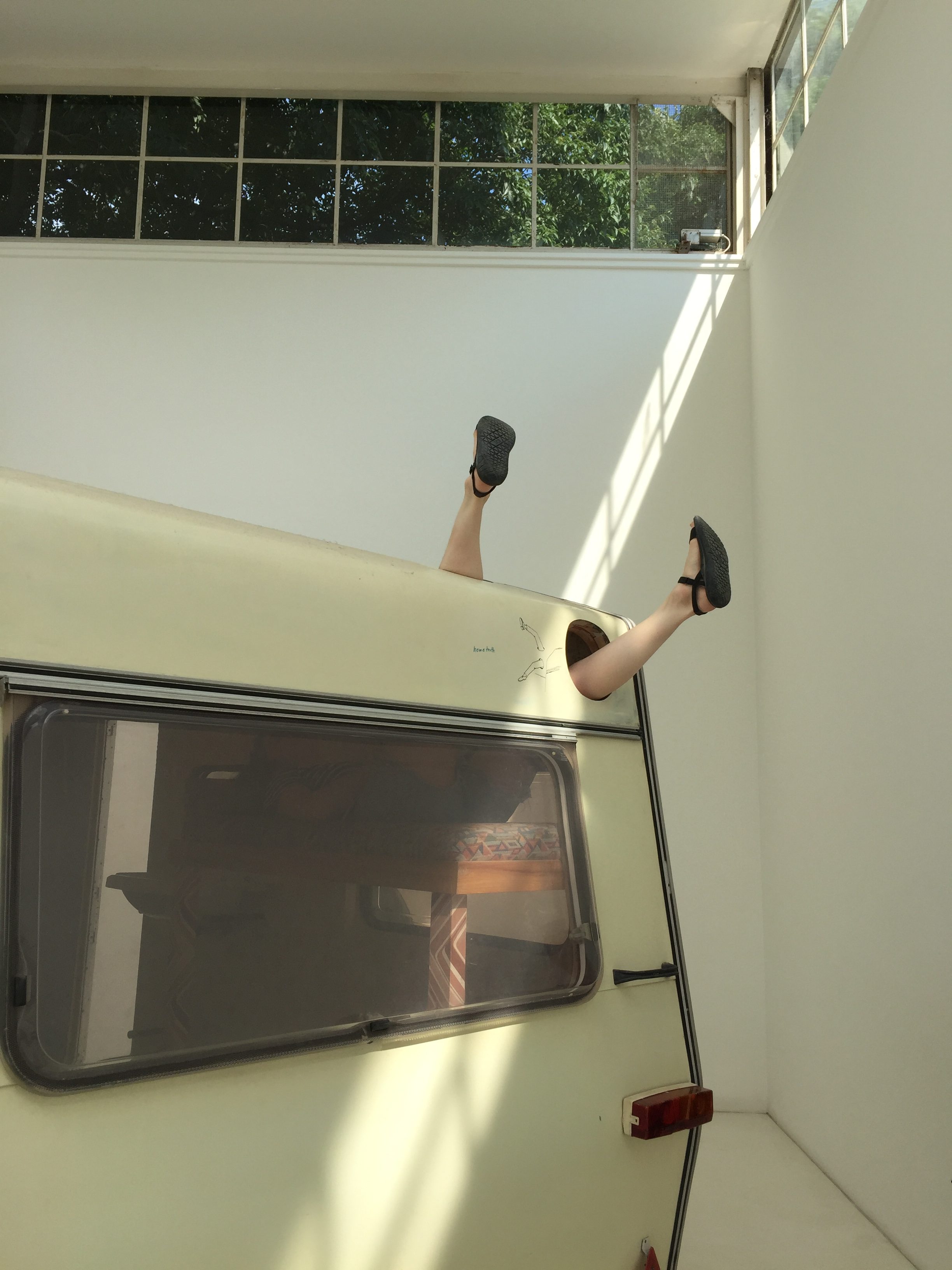
Best known for his interactive sculptures that ask viewers to engage with everyday objects in silly ways, Wurm’s works render the human body into a piece of sculpture and “gives objects human-like attributes” (Nayeri). Wurm is one of two artists, the other being Brigitte Kowanz, representing Austria at the Biennale this year. For his exhibit in the Austrian Pavilion, Wurm has chosen to recreate his famous “One Minute Sculptures.” The exhibition consists of various objects, ranging from a sculpted pair of pants to tables and chairs, distributed across the pavilion floor. The objects have instructions written on them, indicating how they should be interacted with. The viewer is encouraged to adopt each pose with the object for a full minute. One of the main features of the exhibition is a caravan with holes in its sides and ceiling that viewers can stick various limbs out of, often in a humorous manner. I especially had fun reclining on the caravan’s bed while sticking my legs out of the roof at funny angles. However, it was while placing my head on the top of a table turned 90 degrees and attached to the side of the caravan that I started to grasp how Wurm’s pieces were challenging me to reevaluate how I interact with objects in the environments I move through. He thoughtfully uses humor as a vehicle for deeper thought about the utility of the tools around us.
It is this element of humor and fun that leads the pavilion’s curator, Christa Steinle, to state that she chose Wurm to co-represent Austria because “his art is easily approachable, i.e., non-elitist” (Nayeri). Following the instructions on the sculptures and engaging with them does not require any previous knowledge of art or art history. There is nothing convoluted or abstract about how one is supposed to interact with the pieces. Wurm’s approachability results in the Austrian pavilion attracting a more diverse audience, especially in regards to age. When I visited the pavilion, the impressive number of children engaging with the art stood out to me. Children were climbing all over the sculptures, and having a blast– filling the space with lots of giggling. This is not to say that Wurm’s pieces are child-like, but that they can be enjoyed by a wide range of ages. In fact, for more mature audience members the sculptures are refreshing. The way in which they break down the serious façade of the art world is an enlivening break from some of less easily digestible works at the Biennale.
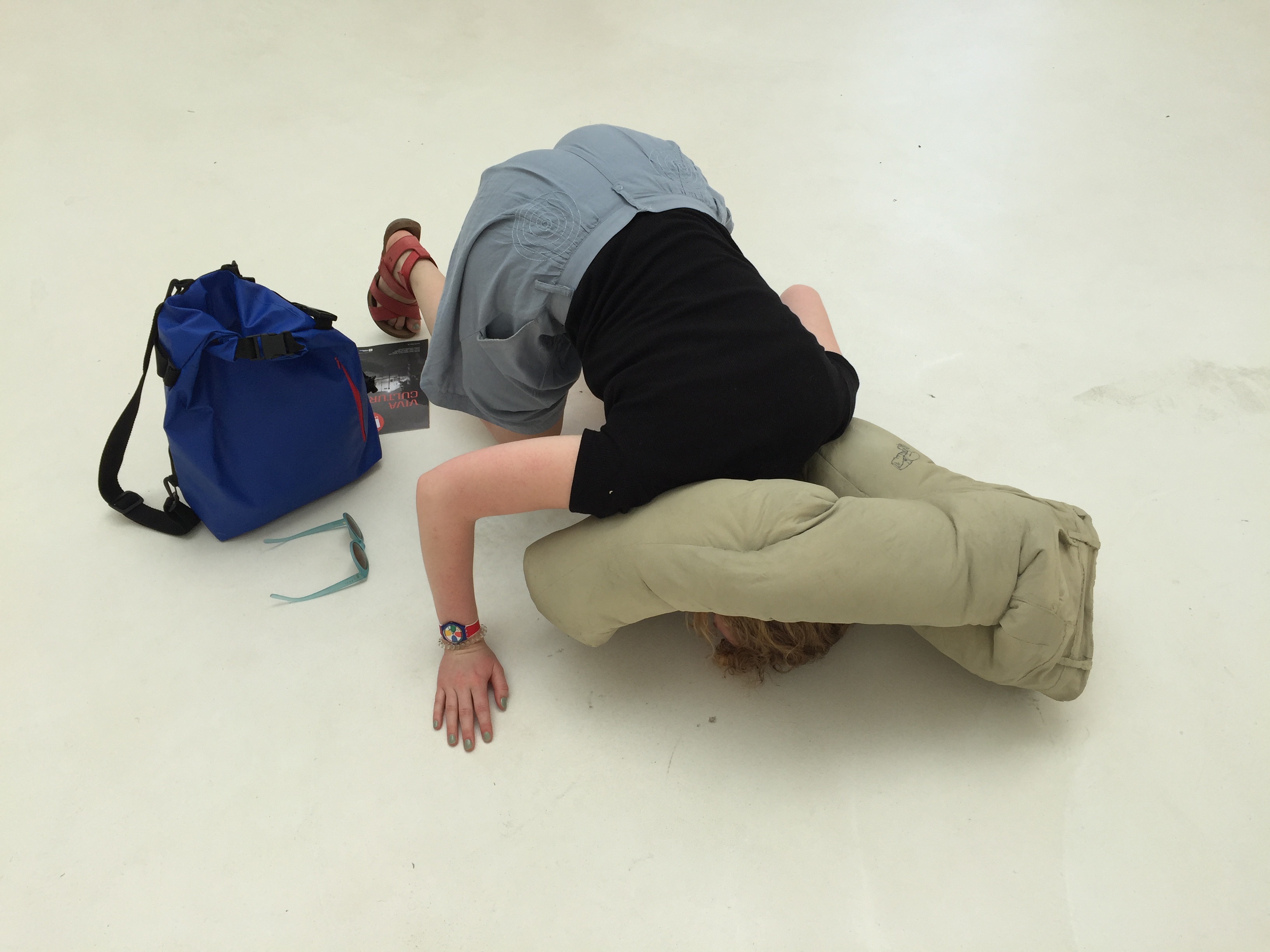
Nonetheless, while Erwin Wurm’s sculptures are more accessible for some groups of people, they continue to put up barriers for others. One important barrier is physical ability. The claim that Wurm’s sculptures are approachable is heavy with ableism– we ignore that interacting with works of art physically does not always increase accessibility. It seems as if the work assumes that the viewer will be able to complete the performative aspects of the work, which require varying amounts of flexibility and agility. The fact that being able bodied is a requisite for full participation and understanding of the work seems to be taken for granted, especially in claims of the work’s approachability and non-elitism. While the sculptures may confront notions of intellectual elitism in the contemporary art world, they continue to fortify notions of able-bodied elitism that exist in the art world and beyond. Indeed, ableism is a trend that I have noticed in many art works that involve viewer participation at the Biennale this year. One example is a work in the Japanese Pavilion in which viewers stand on a platform under the pavilion to stick their heads up through its floor in the middle of an art work. From what I could tell, there is no other way to have this experience without climbing a flight of stairs to reach the platform.
There are other elements of the “One Minute Sculptures” that counter the approachable narrative that surrounds them, but able-bodiedness seemed especially relevant being in a city like Venice that struggles to provide structures supporting physically disabled people. I, and many of my classmates, have noticed that the abundance of bridges in Venice makes it largely inaccessible to those unable to use stairs. There are only wheelchair ramps in the most trafficked areas of the city, making large swaths of Venice unreachable for those requiring ramps. It is the inaccessibility of city of Venice that made me more aware of the issue of ableism at the Biennale. Realizing the extent to which the Biennale is ableist has lead me to ask more questions about how the contemporary art world should approach and accommodate disabilities, both physical and other. Which types of contemporary art are more disability friendly than others? Is contemporary art less accessible than art produced before the contemporary period? And finally, what criteria should we use to evaluate the accessibility of contemporary art to those with disabilities?
Source
Nayeri, Farah. “At Venice Biennale, Erwin Wurm Makes Sculpture ‘a Form of Action.’” The New York Times. June 15, 2017. https://www.nytimes.com/2017/06/15/arts/venice-biennale-erwin-wurm-sculpture.html
Hi
When we did our recent search for a museum director at Carleton, these same issues of accessibility came up. Who is the museum/gallery for? How can you bring people to the museum that don’t usually go to these places? How far should you go in trying to open up to a new audience? What kind of balance do you want in terms of tradition, the art object, and newer forms of art or things that push the boundaries of what we think art is about? Your piece gets to a very smart conclusion-that while the work uses humor to engage a broad audience, the accessibility issue looked at broadly undercuts that. You could also add the accessibility of getting to Venice in the first place. In the dept, maybe due to my age or else due to how I was taught, I guess I represent a more traditional approach to art. Not mindless or blindly opposed to the new, but placing a lot of value on history. In a way, I can see the non-elitist style you describe as another kind of elitism. What I mean is, for someone who values traditional forms of art, you might see many things in contemporary art practice that are so concerned with re-defining what art is that it takes a harsh stance against someone who goes to the museum looking for engagement with something like a great image that one can take in thoughtfully and quietly. And sometimes I think about timelessness. I understand doing work that is important for right now. Artists have obviously done that for centuries. But I wonder, what will last? Who will they look back to inn the future? Who will be the Turner or Kollwitz of today when people look back over a long time span?—- Ross encourages us to try to ask some challenging questions. I am trying to do that. Don’t take my reply as a rebuke.–Fred
Hi Fred, thank you so much for your comment.
Your statement about contemporary art being elitist towards an audience looking to engage with more traditionally representational works of art, like drawing, painting or sculpture, is really interesting. I agree that contemporary art can be alienating to certain audiences because it has departed so far from traditional mediums and subject matters. I can see how for a viewer who has only ever interacted with art by looking at it, the physical interaction that Erwin Wurm’s works require could be very unapproachable. However, I would also make the claim that the concern with re-defining art is not unique to the contemporary period. I think that it is important to contextualize works of art that may now seem very traditional and realize that when they were made they were also revolutionary in the art world. Even what we now consider to be tradition was radical at one point. Your comment raised a lot of interesting questions for me about how we historicize works of art, and how we can sometimes render them seemingly complacent. I think that we could gain a lot from more traditional works if we attempted to look at them through the lens of someone from the period in which they were created.
I am also really interested in this notion of timeliness that you brought up. I think that it gets at important questions about how we will preserve and historicize works of contemporary art that often do not involve a physical art object. Erwin Wurm is a compelling example here because his works merge sculpture and performance, the concrete and ephemeral. What are different strategies being used my museums to display non-material works of art, such as works of conceptual art or performance art? If it is difficult to translate these works into the context of art institutions how will they ever be digested by the public and historicized? I also think that this idea of timelessness gets at the fact that so much of the contemporary art we have seen on this program is responding directly to current social and political concerns, especially the refugee crisis. Will art that is so specific to this moment stand the test of time? I think that the cyclical nature of history renders period specific works of art timeless, but that may just be me being too optimistic.
Thank you again for your comment! -Juliette
Considering the fact that “relational” aesthetics often find their foundations within potentially “high brow” art institutions such as the Venice Biennale, does this really speak to humanism in any way which might really make a difference for accessibility to the majority of people who aren’t fortunate enough to attend events such as Biennale’s? If people are interacting with other people who can afford to go to the Biennale, aren’t connections being formed among people who might be too similar, at least economically or socially?
If one comes to this piece alone and does as Wurm instructs, is the effect the same as if one is attempting to do it with friends (I ask because I know that many students from Carleton went together, and so perhaps had a different experience)? I love when a piece of art turns the lens around so that it faces the audience, so that we become art ourselves. The piece cannot be complete without participation. There was a similar piece in the Pavilion of the Common, Franz Erhard Walther’s Wall Formation ‘Yellow Modeling’, which requires two people to engage with the piece simultaneously and form a visual bond across a room.
I appreciate how genuinely fun and interactive the pieces look. It is a point of levity, similar to the Lady Bunny video or the David video. One question that I have is whether or not there seems to be a message given through Steinle’s piece—although the art is accessible to the “average” public, are there other layers made visible through didactic material or the structure itself which people might engage with if they chose to?
I really like your fresh look at ableism—honestly I haven’t thought about it much in context with performative or relational aesthetics before reading this. Do artists have any sort of responsibility to attempt to increase that accessibility, or is it their prerogative as artists to make what they each envision as individuals—if that doesn’t include a ramp, then so be it? And expansion upon this issue of physical accessibility: it seems as if institutions with more money and more prestige are perhaps more likely to have this accessibility, leading to even more of the art world and visitation being centered around the same institutions over and over again? Smaller ones might be stuck in a vicious cycle wherein they alienate potential audience members, but it’s more due to a lack of funding than anything. This might reinforce the prominence of more wealthy institutions, whom are giving even more power to “value” certain types of art, while others might not.