Traveling the world for art is by no means an all-inclusive notion. It plays into notions of capitalism and can undermine the audiences experience of large exhibitions like Kassel’s Documenta as art critics often rush through the exhibition and are unable to see all of the exhibition. Although I generally disagree with traveling for the sake of viewing art, I think it creates a unique opportunity for performance based works to present themselves to audiences.
From my experiences on this program, I have noticed many performance based works that I did not expect to find. The NSK State Pavilion, although it was not officially a part of the larger exhibition the Venice Biennale, it was part of the exhibition. NSK is a state in time designed by a group of artists. The country is in effect without an ownership of land. NSK also issues passports to citizens. Leather bound, official passports that can occasionally, unofficially be used to cross borders.
Before entering the pavilion, an attendant advises one to walk slowly and explains that the room can be quite nauseating. The room was extremely disorienting. It was tilted at approximately forty-five degrees. One started at the bottom of the room and slowly worked their way around it, reading responses to interview questions, quotes from individuals, and video works. I never fully adjusted to the space.
Once one clumsily makes their way up and into the next room, they walk down a series of stairs to a table. The table is the outline of a circle and has a trampoline in the center. On the table, there are books containing philosophical ideas, information on the NSK State, and more interview responses including space to leave one’s own responses (as I did). There are two attendants seated at the table and one has the opportunity to become a citizen of the NSK State at that time. One of my classmates decided it was such a cool and hip state that he decided to become a citizen. The attendants told him to fill out some online forms and he was required to have his photo taken. Once he completed those tasks he was told to wait for eight hours while his documents were processed. In disbelief, he asked whether he should leave and come back or what he should do. He was told that many people sit and wait for twenty hours and that he should sit and wait. So, we waited. We waited and had a conversation with the other attendant until my classmate was told that his documents were processed and he would have go to the officer in command to collect his passport. As it turns out the officer in command was casually at her desk twenty feet above the floor. One can imagine our confusion and later surprise as my classmate was told he should try jumping to the officer using the trampoline (the trampoline was not close to the officer by any means).
The two attendants brought over a staircase after a moment and my classmate climbed up and collected his documents. He came down as a citizen of the NSK State and was immediately tasked to help replace the staircase and pay his fee. The room’s disorienting effect, interview questions, paper pushing, waiting, and antagonizations towards my classmate were all apart of a performance. A performance that attempts to provide a similar experience to what customs is like for migrants.
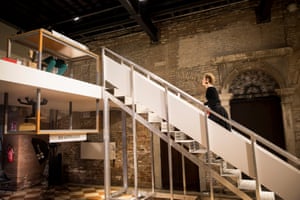
For me this was a unique experience. When I received my passport, it was not disorienting or antagonizing. It provided me with a deeper empathy for what migrants potentially experience. It was an experience I do not think I could have had without traveling to see the Venice Biennale. I recognize that it is possible to have this work displayed in a place like Montreal, Canada; however, I think there was a relevancy to the work being in Venice. To being a work created by artists surrounded by art and to being castaway by the Venice Biennale instead of included as a state.
I do largely disagree with art critics and collectors traveling to art hubs for the sake of viewing art is a poor practice. It is not all-inclusive and creates a disadvantage to those who cannot afford to travel to these exhibitions, however I do believe it creates a unique environment for performances such as the NSK State Pavilion and this environment can lead to discussions that were not possible before.