For the past few weeks, I’ve been astounded and amazed by the art that we have seen in Venice and now in Cologne. In addition to the contemporary art, which has proved provocative and fascinating, I’ve been floored by the wealth of older, historically significant works that we have had the chance to see. Many of the pieces I had studied in class or seen only on slides and never thought I would have the chance to see in real life. One such piece was the Ghent Altarpiece. Completed in 1432 and painted by Jan and Hubert Van Eyck, this altarpiece is a masterpiece in every sense of the word. I’m usually not a fan of altarpieces, a discussion I’ll reserve for a later blog post, but I love the Ghent Altarpiece – to the point that it is the focus of my upcoming German thesis.
While I had seen the central panels before, I never thought I would have the chance to see all the panels together. Luckily for me, seven years ago the art world decided it was time to restore the altarpiece. This meant that the altarpiece would be brought to Ghent where it would be displayed at St. Bavo’s Cathedral with the MSK (Museum Schone Kunsten) working simultaneously to restore various panels (as different pieces were being restored, they were replaced with replicas in St. Bavo’s). With the city of Ghent only a three-hour drive away, a group of us embarked on the road trip. After a few stumbles with the rental car and an impressive amount of waffles (five people, five hours, 16 waffles), we arrived in Ghent and made our way to St. Bavo’s Cathedral.
St. Bavo’s Cathedral in itself is beautiful. The gothic style Cathedral is impressive with high, vaulted ceilings and alcoves filled with other altarpieces and religious statues. The Ghent Altarpiece, however, is in a side room. After paying for the ticket, visitors enter a smaller, dark room with the altarpiece placed front and center.
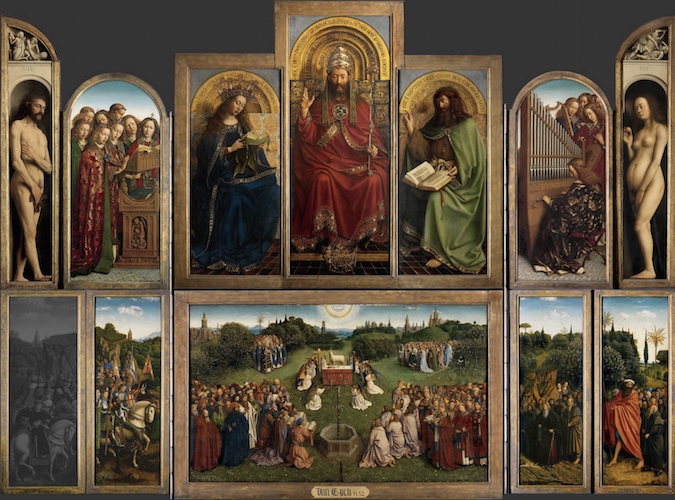
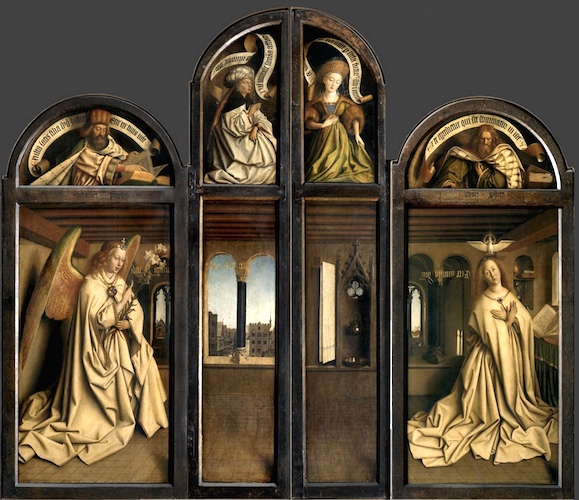
To be completely honest, I almost started crying. The silence of the room, talking was not allowed, set a serious, almost reverent atmosphere and the piece was even more impressive than I anticipated. To start off, it’s huge and extremely complex. The altarpiece consists of outer and inner panels which total in 12 on the outside and when opened reveal 12 panels on the inside so a total of 24 panels. Although safely positioned behind glass, visitors are allowed to get pretty close to the altarpiece and there is space to walk around the work and
view both the outer and the inner panels. I was stunned by the richness of the colors in addition to the details and clarity of the jewels on the robes of Jesus and John the Baptist.
Leaving the altarpiece, somewhat unwillingly on my part, we made our way over to the MSK (Museum Schone Kunsten) where The Adoration of the Lams was being restored along with the rest of the lower register of the inner panels. Normally you would be able to see conservators working, however we arrived right before the museum closed. Set up on easels in a side room, the four panels are far removed from the glass. Contrasting to the dark, serious church, these panels were lit with fluorescent lights. Although the text panels that described the panels and informed about the stage in the conservation process were interesting, the room had a very sterile feeling. The pieces just seemed to be lacking and no tears were shed.
Over the past few weeks in class, one topic that we’ve discussed in depth is the idea of the museum as a “white cube.” Largely used as a negative, the “white cube” describes the clean, formal, almost-sterilized spaces used by museums to display works of art. Think of the typical gallery with white or solid colored walls that show large oil paintings. In class, we discussed how artists began to question the so-called “white cube” and asked whether these spaces in fact had a negative affect on the artwork and the ways the viewer interacted with the art. In Venice, for example, many of us noted that exhibitions in warehouse-like structures of the Arsenale or smaller chapels gave the art a different feel that the white walls of the international pavilion or in the Academia Museum. I understood the significance of the “white cube” in theory, but couldn’t put my finger on it in actually. I definitely had an “ah-ha” moment with the Ghent Altarpiece. Even with a few of the most significant panels only represented as replicas, the altarpiece was so much more impressive in the realm of the Cathedral, in that dark, quiet room, and in its entirety. In the “white cube”, it just became another panel from any altarpiece.
Hi Julia, Your ideas about the white cube versus viewing the piece in the Cathedral I totally vibe with. Having this experience with the Ghent altarpiece in its original location makes me think of other works we have seen and how they could potentially have more of an impact if taken out of the white cube. For one, there are so many altarpieces that are away from their respective churchs and we see in museums. These tend to be pieces I am less interested in, but I wonder how my perception of them would change if I saw all of them in their original location. This idea can also alludes to the dangers of museums in general, that they can overly decontextualize artworks or artifacts causing them to lose some of their meaning and significance (a prime example of this could be the Intuition exhibit at the Fortuny). So I also really appreciated the effort made to bring the panels all back together again in Saint Bravo, even with some of them being replicas due to restoration.
Great post Julia! Jumping off William’s comment, I also saw quite a significant amount of value seeing these all together, even if they were in their reproduced form. Getting a clear vision for the full glory of the panel and the intention it was commissioned for was far more evident in the original location. I’m curious how you felt seeing the central panel’s in Berlin. How was that space compared to the original location at St. Bavo’s?
I really enjoyed how you encapsulated your feelings about the altarpiece, obviously as a work that means a lot to you. I’m curious about your reaction to other altarpieces. Do you feel similarly about other altarpieces existing in white cube spaces?
I felt similarly about seeing the altarpiece in the museum. Even with the added glass, there felt like quite a separation between the viewer and the art, something that would not have been present in the original glory of the piece. Even if clarity is better in a museum, it is far better (personally speaking) to see works in their original context.