Most people are familiar with the story of Pinocchio, the marionette turned real boy who is led astray towards lying and his own desires. The original story written in 1883 was aimed at the public to combat lying and laziness, addressing themes relevant to the times.
Shifting now to 2017, Rachel Maclean, the Glasgow-based artist representing Scotland’s pavilion, uses this well-known story as a base for her massive film installation, examining instead, worries and concerns of the modern day: consumerism, truth, media, corruption in politics, and extreme masculinity.
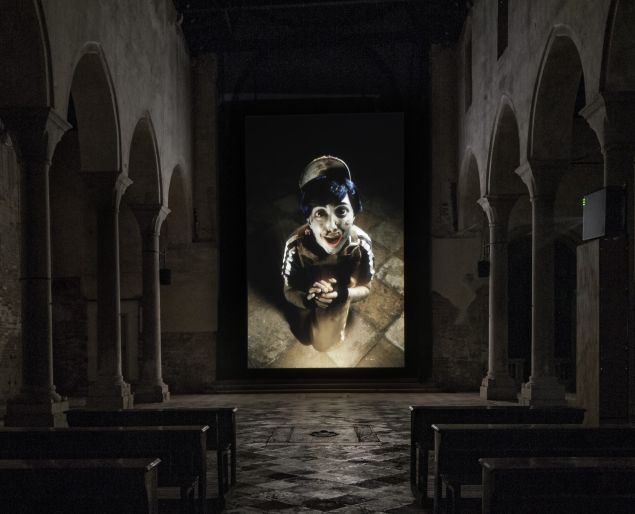
To provide a quick summary of the installation, after being ushered in the pitch black you are confronted with an eight-meter high video in the apex of the former church. You are seated in pews, mimicking a worship of these consumerist ideas while receiving the messages Maclean preaches. One of my favorite aspects of this work was Maclean’s use of extreme site specificity. Within the church formally dedicated to St Catherine of Alexandria is a sculpture of the saint herself. In the film, Pic, the main character, visits this statue. You are taken from the absurd video back into the real world with this look directly at the physical space you inhabit.
Although difficult to begin summarizing due to the looping nature of the film, the story looks at Pic, a boy who worships wealth so excessively that he becomes the spokesperson for “Untruth,” a brand of perfume that does none of the things it says it does, besides making you a liar. As Pic’s nose grows with his lies, as does his obsession with power, masculinity, and wealth. In another world dominated by browns and greys, Pic is a poor boy, covered in welts, begging for money, waiting for his chance to be rich. Once he gains this status, his iconic nose shoots his message of “Untruth” into celebrity.
Formally, I found this piece to be fascinating. Most notably, Maclean’s film exists in an endless loop, with no beginning and no end. This intentional structure parallel’s the absurd universe we enter, one primarily of discomfort. Additionally, Maclean plays every character in the film. Using prosthetics and make-up, she transforms from one person to the next. Despite the obvious and sometimes video game-esque green screen, Maclean’s video was crisp and primarily colored in blue and gold. She cites aesthetic inspiration from the early Renaissance painters Giotto and Masaccio. Although gaudy, the saturated colors produce a greater distinction between the world of wealth and the dreary world of poor, necessary for this vast difference to be evident. Creating such a divide between these opposing realms, further examines our present social divide between the rich one percent and the rest of society. Maclean uses a version of poor Pic within the rich world to intertwine the two worlds, with the wealthy ultimately hunting poor Pic down for the “stench” he brings to this exclusive space.
The binary of Truth versus Untruth further investigates what is real in this age of social media and false claims by politicians. The Untruth perfume is snorted, sprayed, and worshiped into reliance and addiction to a false narrative. Absurdly, this is not too far from our reality. Truth in politics has been a major question in the past year. Without identifying a specific political figure to critique, Maclean looks directly at modern politics and the media. Having written the script just after Brexit and Trump’s election, Maclean uses Pic to critique these notions of truth and how our modern society is accepting far-right views, centered on wealth and the abuse of lies.
What Maclean does with the Scottish pavilion is remarkable in comparison to the rest of this year’s relatively underwhelming Biennale, in terms of political response. No other work that I have seen directly confronts similar super contemporary political issues, responding to Trump and Brexit, like Maclean does. And for that I think Spite Your Face is extraordinary. The attached article begins by stating that obviously artists would use this year’s Biennale to examine recent political events. But this doesn’t seem to be accomplished with many other pavilions, nor was it addressed in Viva Arte Viva. The Scottish pavilion stood out for being one of the only examples of a work that looks directly at the politics of the moment, addressing them honestly and without fear of consequence.
To get across these themes honestly, Maclean uses strikingly graphic images on two occasions within the film, one done effectively, and the other completely unnecessary and aggressively out of place. As Pic begins to buy clothes and shiny things to fit his new glittering body, with each swipe on the machine, the card cuts deep into Pic’s wrist, giving him a rush, but also a deep pain. This self-harm through consumerism shows this wealthy desire for aggressive and over-consumptive behaviors. Using this intense graphic imagery that sticks in your mind emphasizes further the harm of consumerism without thought.
In another scene, Pic engages in nose masturbation, fueling his lies further. Soon the Blue Fairy (the primary female character) arrives. As the scene progresses, Pic retaliates aggressively, calling her a “bitch” and raping the Blue Fairy with his nose until they are both bleeding. Although in the handout available upon entry into the space, this scene is outlined as a way to address the abuse of male power, Maclean takes this longing to confront the viewer in a visceral way to an upsettingly unnecessary level. Including a rape scene within this context simply to address this issue was a poor choice on Maclean’s part, when the same message could have been produced in other ways, without the excessive violence and pain of a rape scene. Juxtaposed with the rest of the film, this scene feels out of place.
Beyond that, my critique of the Scottish Pavilion is inexistent. I found Maclean’s critical examination of the modern moment to be spot on. She utilized space and place in an extraordinary way. Making art that is responding to our contemporary moment is exactly what we need right now. It is important that Maclean used this work to unpack many of the uneasy feelings we have as citizens of the world, unsure of the future we are entering politically, and how similar it will be to the untruth apocalypse we experienced here.
Uniquely, she also directly responds to Venice, using Pinocchio’s place-based recognition as a starting point. Personally, I feel her critique extends into Venice and the fakeness of the overwhelmingly present wealth of this city. This sense of place further harkens back to Pinocchio. Ultimately drawing from an old story, set in a world of modern political fears and problems, Maclean was successful (sans the nose rape scene) in her execution and addressing of these issues, although upon initial thought, it seemed as if she attempted to address too many issues, and may have benefited from narrowing her focus to one or two themes. But in reality, this is the world we face, and Maclean seeks to hold a mirror up to our own truth, a world filled with lying politicians, aggressive consumerism, and violent patriarchal figures and ideals. Hopefully our reality will not be a never-ending loop.
Article referenced, image used, and further thoughts on the Scottish Pavillion:
http://observer.com/2017/05/pinocchio-rachel-maclean-scottish-pavilion-venice-biennale/
Thank you. Interesting that the artist showing in Italy chose a local character, Pinocchio. Thank you for describing what she did with that theme.
Love the line “hopefully reality will not be a never ending loop.” I agree, and I think it is a shame, that the Venice Biennale was politically underwhelming politically. Sometimes it felt like it was playing along with the “tourist-attraction” facade that much of Venice exhibits. I’m really glad I read this article. I didn’t get to see the Scottish pavilion myself, but the essay was descriptive enough that I got a decent understanding of the installation. The work sounds so cool, from the site specificity to its commentary on consumerism and the idea of what we “worship.” The work sounds very direct, confrontational and graphic with its political statements, which seems to be impactful and powerful in conveying messages about modern society. I really like how it speaks directly and loudly about falsehoods in politics and media. The work touches upon themes that are so important, historically and in recent times, and it is a work that creates the needed discussion on the recent elections and global political events. Im hoping I can youtube it!