I have been on the hunt for some radical eco-activist art.
Given the state of our planet and the urgency felt by many across the globe for mass action towards ecological change, I assumed multiple examples of art in Documenta and the Venice Biennale would be commenting on this trend and even artists would position themselves in stark opposition to recent developments of environmental related issues, such as Trump’s pulling out of the Paris agreement and other ecological catastrophes that are waiting to happen if action is not taken soon. I assumed this sort of commentary would be at the center of these shows, with a multitude of works commenting on this pressing issue, but this has not been the case.
When I first saw that the Pavilion of the Earth was one of the central trans-pavilions as a part of Viva Arte Viva at the Biennale, I was eager to see how artists would respond to the environment, and their ideas for the future. But there was nothing radical or even remotely moving about this pavilion. It simply looked to the earth and used it as a source of inspiration. In no way am I discounting looking to our planet for inspiration in the art making process, but in the moment we are in, we need more than admiration to propel us into a healthy future, especially when an entire pavilion is going to be devoted to the cause. In my eyes (sans a few fascinating works for unrelated reasons) this pavilion failed. My desire to find radical eco-art had to wait.
Beginning exploration of Documenta 14, I had given up, thinking that I would not get to see the eco-activist art of my dreams. Until I entered the Neue Gallery yesterday.
The Neue Gallery at Documenta, has a room of works by Annie Sprinkle and Beth Stephens. Most of the space devoted to this former sex worker and porn-star, turned queer activist and artist (Sprinkle), is archival, detailing past performances, events, signs, and pictures. Although I usually do not care for archival material in these modern exhibition spaces, this was a moment where I felt it really worked. The content did not feel outdated, rather commented on issues we are still facing today, while looking back at the life and work of these two very interesting female artists. Many of the images on the wall as a part of Sprinkle’s early works were pornographic, and a tiny video (Public Cervix Announcement) was even shown inside a speculum.
And yes, it was through these radical sex works that I encountered eco-activism.
Sprinkle and Stephens are a queer couple, now doing works together. The section they have completed more recently focuses on the earth, showing their communal shift in subject from feminist politics to ecosexual activism.
Ecosexual activism, a term I had never heard before, focuses primarily on a shift in how we think about the earth. This shift in thinking is best illustrated in Sprinkle and Stephens’ artist statement:
“People often think of the Earth as ‘Mother Earth.’ But today the Earth is so battered, abused, exploited; polluted, blown up, and ripped apart, that she can’t handle the burden of being a ‘mother’ any more. It would be better to think of the Earth as a ‘lover’ because we take care of our lovers instead of expecting them to take care of us.”
Through reading this text, I realized I had found what I’ve been looking for.
This radical, yet very simple notion of switching the language we use from “mother earth” to “lover earth” flips the way we conceptualize our planet. The result of this shift in language is what is radical. Treating the earth more parallel to a lover rather than a mother is a beautiful idea, one that will keep nature and humans in a symbiotic relationship, void of exploitation and the expectation that the earth will take care of us.
This shift forms the root of Sprinkle and Stephans’ idea of eco-sexuality. But they let you define this identity in your own terms, equating to a general care for the earth for some, and a more erotic fascination with the earth for others. Ultimately they use this idea to make environmental activism more sexy, fun, and diverse, deconstructing the heterosexual notion of nature that has been constructed in typical ecological activism.
One example of this deconstruction is their continuous performance piece surrounding the notion of love. Through this performance, Sprinkle and Stephans stage a wedding every year. Each wedding, they marry a different part of our environment. The earth, sky, sea, moon, sun, and even the Appalachian Mountains have all been wed to the couple. Through this work, they seek to both normalize queer life, and take a stand against the vast ecological destruction that is occurring throughout the world. They become lovers with the earth and take on a care and love for the planet that we all should.
Most of their other works are on a smaller scale than a wedding, using posters, stickers, and buttons to promote eco-sexuality with phrases such as “Composting is hot!” Their largest eco-sexual work in the space is the 25 Ways to Make Love to the Earth. This poster lists 25 ways one can embrace eco-sexuality and love the planet, further looking at how we can interact with the earth as its lover.
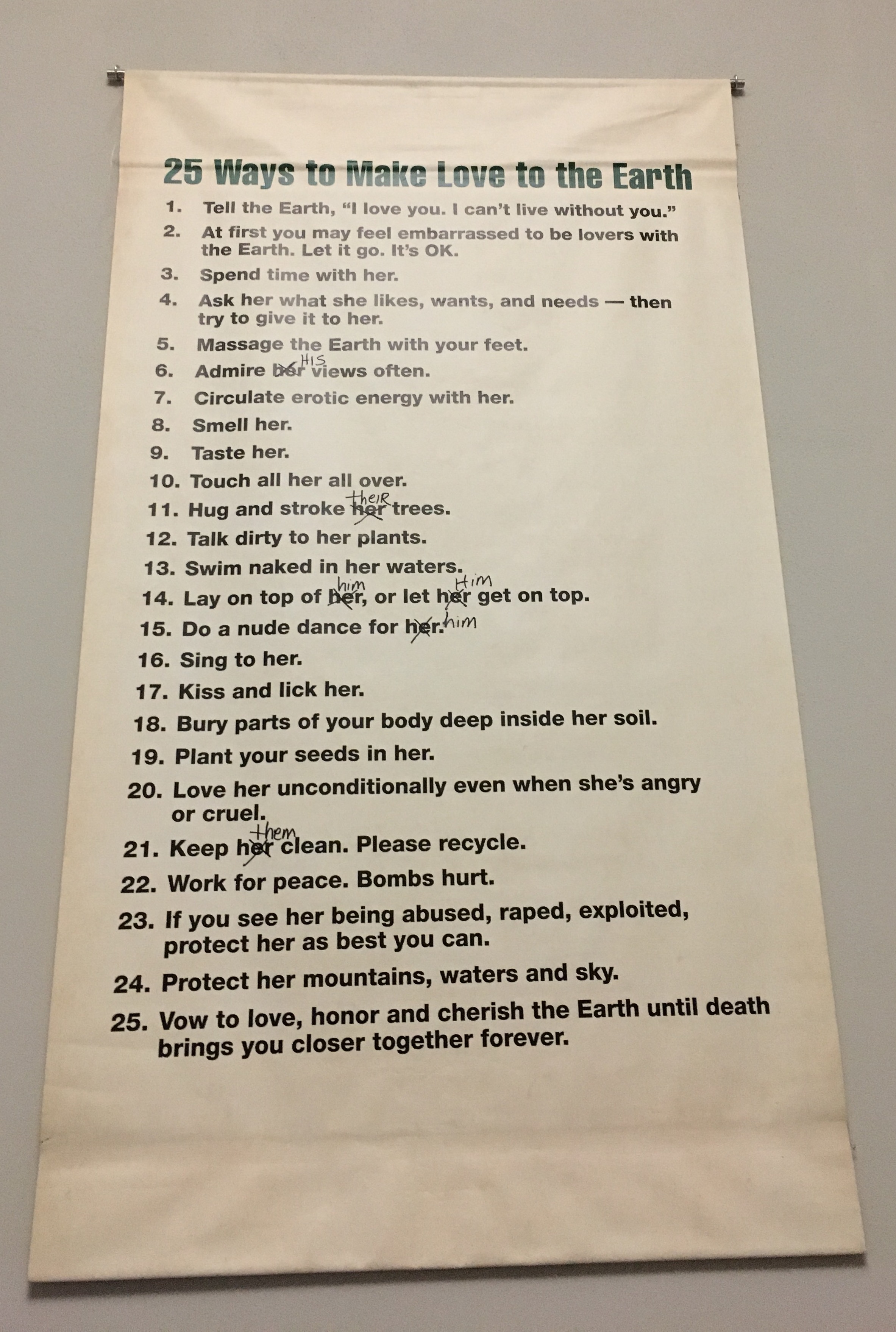
This ecological activist discussion is critical to have in the present moment. I am surprised to have found this primary example of conversation amidst ideas of radical sex, but this more intersectional approach to environmental activism falls in the ideal place to begin this conversation and generate further ideas surrounding environmental activism.
There is obviously much to cover when artists are responding politically and socially to the modern day. Although environmentalism may not be at the forefront of this year’s mega-exhibitions, Sprinkle and Stephens provide this tangibly radical approach to a critical issue facing our world in the best of ways, leaving the viewer to think critically about their role on the planet and how they can begin to consider our planet no longer as a mother, but as a lover.
This was the radical eco-art and environmental activism I was searching and hoping for. Although found unexpectedly, eco-sexuality brings up beautifully radical ideas that have the potential to transform our earth, our Lover Nature.