During midterm break, I was fortunate enough to visit the East Side Gallery, a 1,316 meter stretch of the Berlin Wall. It depicts about 101 different paintings from numerous artists around the world and expresses the sheer joy of the fall of this infamous structure as well as the hopes and dreams for a better future. Most of the art that now can be seen on the Berlin Wall were devastated by vandalism and erosion, but, in 2009, an extensive restoration occurred and some artists even had to repaint another copy of the artwork that they made in 1990. Along with inspirational quotes and didactic materials, this preserved section of history looms spectacularly among the endless sounds of construction and train cars.
I have always been a huge fan of murals and graffiti. The raw richness of open-air art gives a sense of community because it is there for all to enjoy. By stripping away the institution of the museum, open-air art is there to be appreciated without any barrier, the most accessible type of art I believe there is. For me, this makes the art more profound and impactful because the backdrop of museums dull the artworks by putting them against others in order for the curator to create a specific meaning. The art seen in exhibitions is put there to serve a purpose, to shape the vision of the curator. In the case of open-air art, the setting is the outside, the real world where humanity resides and there is no curator creating a buffer between the natural perception of the viewer and the art itself.
My favorite work at the East Side Gallery is a mural entitled Les Yeux Ouverts by Muriel Raoux. It displays a young girl surrounded by a landscape swirled with wind-blowed images and houses. An old woman looks into the distance with a pale and forlorn face as two sides of a wall, presumably the Berlin Wall, break apart to create a passage for the viewers to gaze upon the image. It is the simplicity of its message that I found to be the most important. Les Yeux Ouverts means “The Open Eyes” and I believe this work is a commentary on the past, present and future. The young girl is not looking toward any other direction other than forward. It seems as though she does not want to indulge in what is behind her, but rather look forward into the future of the world, which is the viewer. The viewer is able to stare straight into her eyes as if to promise that her hopes of a better future will be fulfilled with the generations that are able to witness this work.
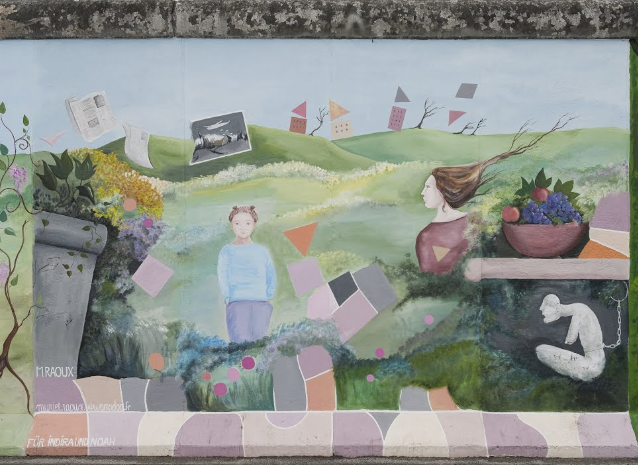
The old woman is completely taken aback with the actions that unfold in the background. She is an older representation of the young girl, watching all the different ways the world had changed before her very eyes. The past seems fleeting as the present holds the entire mural together. The older woman is looking away from the audience and seems to be an example of what the audience should not do; forget about the past. The past gives insight as to how to change the future for the better while, most importantly, remaining in the past. The repetition of history is the opposite message of this piece, but rather a warning that another Berlin Wall will not serve the world well.
It is crucial to note that although the young girl is bestowing the responsibility of the future upon the viewer, she makes a point to emphasize the rest of the mural. The audience can see the past as well as the present and by seeing all parts of the mural, it serves as not only as an instructive piece, but also sets the stage for a newfound covenant between the mural and the audience. This covenant utilizes the images of the past and the present in order to ask the viewer for a more promising future. This bond is not blind, instead, it is an informed and conscious choice that encourages and fuels the power each individual has to change the future. This work gives the viewer the tools to complete the task at hand and leaves no doubt as to the ability of the audience.
The title of this works seals the message of this work. In order for the idea the work is entrusting with the viewer to be accomplished the first step is to approach with open eyes. Naturally, this offers the notion that by turning a blind eye to terrible acts in this world, another Berlin Wall will be inevitable. Open eyes create an obligation to the visibility of what is happening around the audience and a physical component to this promise. This enables the audience a chance to ground this rather proud notion that the world will be all and well if the audience learns from the past. However, learning from history is not the only way to solve the problems of the world. Subsequently, giving the agency to the viewer and commanding them to open their eyes does not allow for the loosening of this promise. I hope that those who visit this artwork around the world open their eyes to the sacred covenant of humanity that this piece desperately desires from the viewer.
Hibo Abdi,
I wish I wrote as well as you do. I write entirely about genealogy so will advise you , because I think you care about your writing and since I cannot restrain myself from offering this critique. Rather than say young girl and old woman, I would give their approximate ages. Young and old stand for different ages depending on the viewer or reader. IN your piece I might say girl and woman in about her forties. After that you coudl just say woman. Given I am in my fifties and am middle aged, going on old, this “old woman,” looks much younger than the woman I see in the mirror. I have some white in my hair, she does not. Again I would give numbers rather than use the words old and young. A girl about age eight … . Then the reader can change this into young and old. Your readers are not all 21.
Also the word “always” when you wrote it made me smile and laugh at myself. You have “always” liked murals and graffiti? It reminds me when I applied to grad school, I wrote” I have always wanted to be a foreign diplomat.” My mother asked, “Really?” The world would be a worse place had I been in the diplomatic corps, given I lean to creating rifts rather than patching them up. How about, I like graffiti” or I have long liked graffiti or since age eight I have liked graffiti or since seeing trains covered in it in Chicago I have been interested in grafitti … ? or because I have lived in [Chicago] and see it daily I like graffiti, and murals too.
Sorry I did not comment on the substance of what you said. Les yeux ouverts is open eyes, but I am thinking not-naive too is a feeling I get with that expression. Or is my feeling from the American expression I walked into the situation with my eyes wide open? Probably. Be aware that my open eyes is les yeux ouverts too. I woudl not translate the “the” here. Just open eyes. Don’t know. Le, la, l’, les can mean all in general or the, either.
Thank you Mrs. Lynn for your critiques! I will begin to explore what you have brought up through my exhibition reviews and I will be more careful in my word choice. Thank you for also consistently commenting on my blog posts, I appreciate your enthusiasm and dedication to this blog and its members!