Documenta 14 was, among other things, an exploration of place and history. Artist, teacher, and curator Arnold Bolde established documenta in 1955 as a modern art exhibition in the wake of the fallen Nazi Regime, where modern art was branded with the title “Entarete Kunst” and banned due to its alleged un-German, Jewish, or communist nature. The exhibition has traditionally been quite politically motivated. Since it’s founding, it has been held in Kassel, Germany, every 5 years. However, in 2017, with the working title Learning from Athens, Adam Szymczyk and his curatorial team held the exhibition in Athens, Greece, in addition to Kassel. While this moves this art exhibition away from it’s traditional western center, it also creates a sort of “immigration pattern” of visitors who must travel between both countries to see the whole exhibition. These art viewers trace the same route taken by vast amounts of political refugees who travel from the Mediterranean to reach the economically stable western European countries. This was the first of many examinations of space and place.
I was only able to visit the Kassel site of documenta 14, but its investigation of different spaces of Kassel was fascinating. The exhibition was spread out across the city, with sites including the neoclassical Ballhaus atop a hill overlooking Kassel, a tofu factory on the industrial outskirts of the city, and a former underground train station. There were also several larger collections of works housed in larger venues such as the Fridericianum, The Neue Gallery, the Neue Neue Gallery and the Palais Bellevue. These larger venues attempted, with varying levels of success, to present art that engaged with a particular common theme. Because this is a temporary exhibition, the spaces inhabited by works of art were almost exclusively buildings or areas that were not constructed with the intention of art presentation. The art often interacted with the history and original intention of the space.
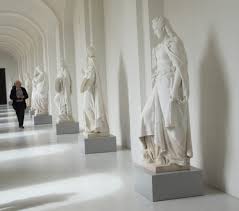
The art collection in the Neue Gallery was a particularly strong example of a larger exhibition that held together strongly and also interacted with the history of the building. The Neu Gallery first opened in 1877, just after Germany’s victory in the Franco-Prussian War. The realization of the Neue Gallery was affected by notions of German nationalism, nationhood, and state building, which is evident in the eight marble Länderfiguren owned by the museum: allegorical female figures that represent the eight traditional “nations of art.” The documenta 14 curators chose to leave these statues—including that depicting ancient Greece—in the gallery space as originally installed.
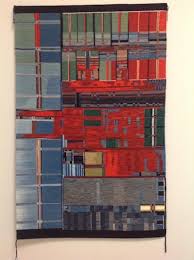
Themes of nationhood and belonging are woven throughout the gallery, which attempts to address historical, economic and political structures of colonialism, dispossession, and oppression. The museum-like collection of works allowed visitors to contemplate how different works of art explored similar themes. For example, Marilou Schultz’s woven tapestries Replica of A Chip (1994) and Untitled (2008) recall narratives of Navajo women laborers employed in the manufacture of computer components. In a nearby room, Hans Eijekelboom’s De Drie Communisten (1975) presents the shared yet divergent histories of communist leaders Marx, Lenin, and Mau. Both of these works engage with different forms of economic systems and question their success. Placing them in the same gallery draws attention to the similar themes evoked by both artists.
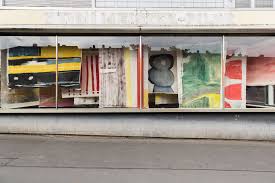
However, documenta 14 was particularly successful in its use of separate, smaller spaces. These sites created a more intimate relationship between specific works and their location. There were a series of installations in Glass Pavilions along the street Kurt-Schumacher-Strasse, which traces a line between Mitte (the center of the city) and Nordstadt in the north of the city. While Mitte is the commercial and cultural hub of Kassel, many Turkish, Ethiopian, Bulgarian, and other migrant communities have inhabited Nordstadt since the 1960s and 70s. More recent migrants from Syria and the Middle East reside there now, as well. These storefronts composed entire of glass used to house commercial outlets, but now sit abandoned by the side of the street. Joar Nango’s installation European Everything (2017) and Otobong Nkanga’s work Carved to Flow (2017) both engage with the physical inaccessibility of the space and the glass walls’ creation of outsiders and insiders. Because most of the pavilions are locked, Vivian Suter’s installation Nisyros (Vivian’s bed) (2016-2017) takes on an added sense of intimacy as one of the only open storefronts.
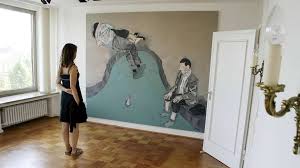
Apostolo Georgiou’s work, exhibited in the Leder Meid Apartment, addresses rituals of domesticity and the monotony of middle class life. Displayed in an apartment stripped of any furniture, the work takes on a new meaning. The apartment, especially within the context of post-Nazi Germany and the refugee crises, feels as if someone has been forced out, leaving nothing behind but a melancholy feeling of loneliness and dislocation. With all its amenities (the refrigerator, kitchen sink, bathtub, and light fixtures) still installed, as a viewer one finds themselves wondering about the people who washed their hands in the kitchen sink, put their food in the refrigerator, and cleaned themselves beneath the showerhead. This atmosphere heightens the emptiness found in Georgiou’s oversized paintings. The people depicted in his paintings become the only inhabitants of the apartment, performing wearisome tasks.
Documenta 14’s exploration of cite-specificity ranged from larger collections of work installed in museum-like galleries to singular works scattered in venues across the city. The expansive design of the exhibition sites encouraged an exploration of Kassel as a city and an investigation of its unique spaces. I found myself roaming the streets of Kassel in search of the Gottschalk-Halle and Gloria-Kino Movie Theater, ducking into university libraries to use their restrooms, and recognizing storefronts and cafes after walking past them half a dozen times in my attempt to find the Narrowcast House. I appreciated the connection to the city documenta 14 crafted, and I think it created a heightened awareness of the exhibitions cite-specificity.
Images: