We have just returned from 5 days in Kassel for the monumental documenta 14, the quinquennial exhibition hosted in the German industrial city for 60 years. This, however, is the first year that documenta has taken roots outside of its German home. The curator Adam Szymczyk split the exhibition in two, hosting half in the traditional Kassel, while the other half was situated in Athens, Greece.
The title, Learning from Athens, reflects this curatorial choice and indicates that the goal of this documenta was to initiate a conversation about the different roles that Germany and Greece play in Europe. Culturally, Greece is the historic home of democracy, while Germany is the historic home of fascism and Nazism; however, both share a home in the neoliberal economic project of the European Union. Economically, Germany is a powerhouse which, in many ways, has been propelling the EU’s solvency through austerity and industry. Greece is a “Euro-poor,” bankrupt, reliant on bailouts, and (some would argue) a threat to EU.
It is clear, then, that this documenta is doubled, engaging in discourse about two economical, historical, and political poles through a geographic displacement. The question becomes: how does this displacement affect the success of documenta? To answer this question, three types of viewers need to be taken into account: the viewer that only visits Athens, the viewer that only visits Germany, and the viewer that visits both. Let’s begin with the Athens-only viewers.
An article from the Guardian newspaper (https://www.theguardian.com/artanddesign/2017/may/14/documenta-14-athens-german-art-extravaganza) notes that very few of the hundreds of thousands of visitors to the Athens portion of the Athens documenta were from Greece; instead, most of these visitors were international art tourists and travelers. It is safe to assume that a large number of these travelers, having the means to visit Athens, also took the time to visit Kassel and complete their art tour. This would indicate that the number of individuals who only visited Athens is small and mostly local, so what did the locals think of the documenta invasion?
The same article from the Guardian notes that appearance of critical graffiti throughout Athens saying, “I refuse to exoticize myself to increase your cultural capital. Signed: The People” and “Crapumenta 14.” Locals, it seems, feel that Szymczyk chose Athens to win authenticity points for his socially conscious, liberal exhibition. The art, to them, feels foreign, out of place, out of touch with the atmosphere of Athens, and too esoteric and theoretical. In this way, the Athens portion of documenta is not for Athenians or the Greek people but rather a new site to which the international art press will flock. Greeks sense an invasion rather than cooperation.
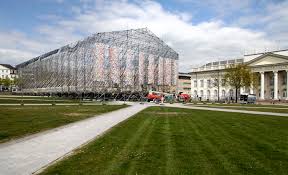
(Marta Minujín’s The Parthenon of Books, 2017. Kassel. Image taken from document 14)
Just because the locals of one site reject the transplant of documenta, however, does not mean that the idea or the exhibition was a failure. Documenta may not have gained social traction in Athens, but does the exhibition have curatorial merit as a whole? This is where the input of the international art press and art professionals who have the time and resources to cast a critical eye on both site comes in handy. Unfortunately, these critics have found the dual-site conceit bloated and obtuse. The press seems to loath the extra travel and effort to the point that even an innocuous “Top 8 Works at Documenta” article from Artnet (https://news.artnet.com/art-world/documenta-14-kassel-highlights-986414) article begins with complaints about the exhibition as a whole: “Bravely facing such nuisances, and the throngs of German and international visitors, our critics did manage to sort out some works that were worth highlighting.”
This is an undoubtably harsh perspective to take, but it reveals the displeasure with which art critics have been viewing documenta. This leaves the locals of Kassel, the most likely group to only visit the German site, to provide some positive perspective; unfortunately, though the typical documenta buzz has enveloped the city, the people of Kassel seem to resent having to share documenta with the Greeks. This leaves me wondering: for whom is this exhibition? Those from Athens will never see the Kassel portion of the exhibition, those from Kassel resent the Athens portion, and the international art press resent the travel. Choosing two site seems to have alienated most of Szymczyk’s potential audiences.
Alienation of an audience, however, has nothing to do with the quality of an exhibition’s core principles and execution, which brings us back to the question of documenta’s success. I found the Kassel portion of documenta to be cohesive, complex, well-organized, and very enjoyable. The overall theme of learning from Athens was timely and easily traceable through much of the exhibition. Additionally, individual and nuanced sub-themes abounded in the individual site, adding richness and depth to the overall experience.
What continues to trouble me, however, is my perception of the Athens site as an art tourist who only visited the Kassel site. In this context, Athens became almost theoretical. It ceased being a physical city with inhabitants, a history, and pressing political and economic concerns and became merely a foil to German austerity and economic might. To visitors only witnessing the Kassel portion of documenta, the Athens was completely reified. The Athens portion of documenta could have been a conceptual curatorial project that existed solely on paper and carried close to the same weight. What this all demonstrates is that Szymczyk ignored the practicalities of international art exhibitions and did not consider the effects of not attending both sites.