A hail to the art world, and the return to aesthetics, this year’s Venice Biennale by Christine Macel is often considered as a failure of not noticing the politically chaotic real world. However, to me, the reason why I found Macel’s central pavilion unsatisfying is not because of the claim she would like to advocate, but the not well-thought organization of artworks to indicate the potential of “Viva Arte Viva”, especially the naming of the nine chapters to limit alternate interpretation on the works.
For this year’s National Pavilion of China, I am firstly glad to notice that there is a place for ancient local art in contemporary art world of China, as my earlier encounter with Chinese contemporary art seems to be highly politicized on the recent history of China and highly Westernized in form and media. To my personal perception, it fits more to the taste of Western viewers, than to evoke feelings among Chinese audience. I am also interested in the future of folk art in China, with shifted audience and interpretations, their choice to keep up with the society and rejuvenize itself. However, though fascinated by the argument curator Qiu Zhijie would like to make in the exhibition, I am kind of frustrated by the real show in the remote end of Arsenale.
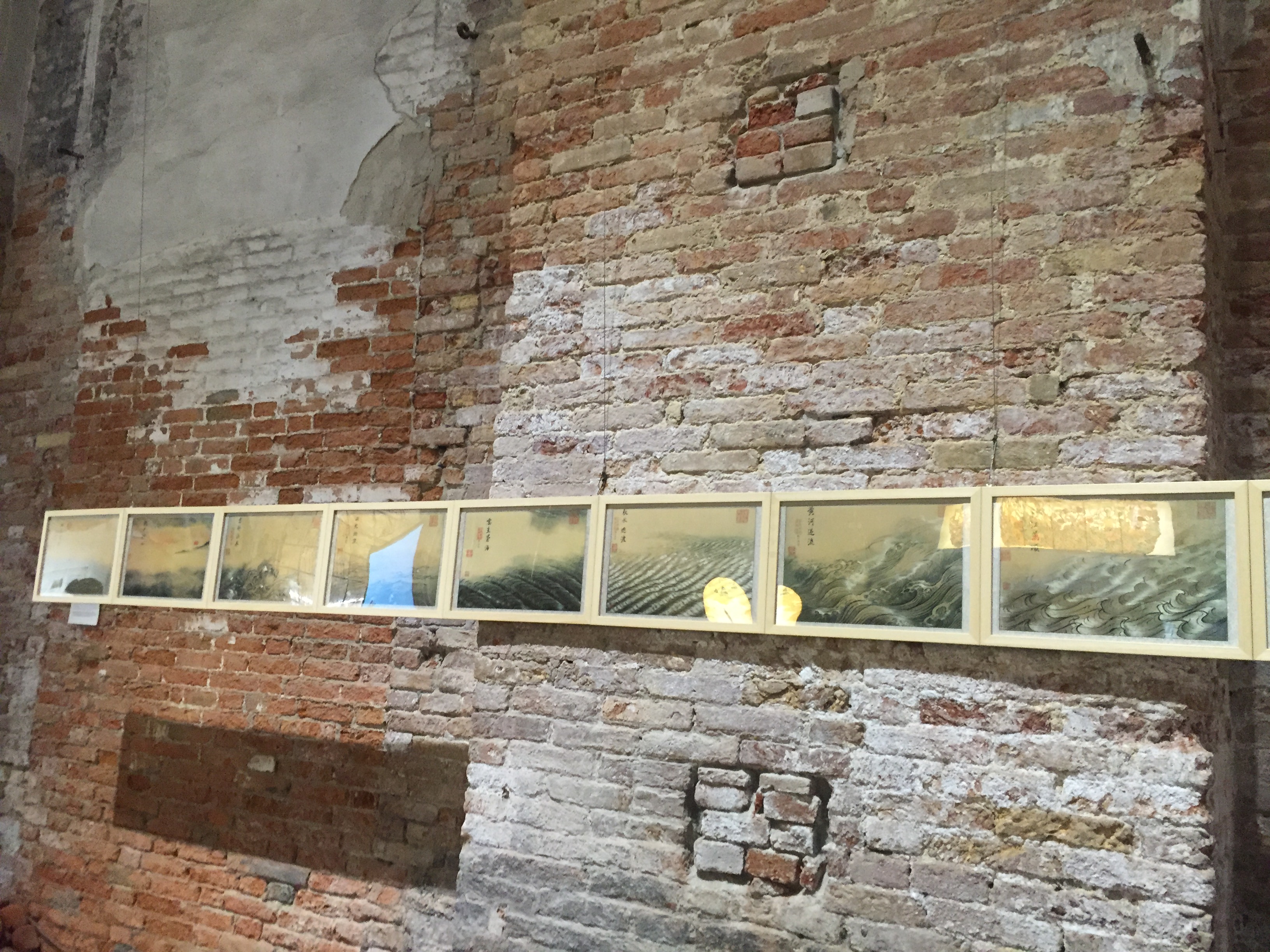
My major critique is about the strong voice of the curator, and his manipulation on artworks. The whole show seems like an already-made project of Qiu Zhijie. The four artists are dwarfed by the giant figure of the curator Qiu Zhijie, a much more famous artist himself. Each artwork can hardly speak for itself, but only makes sense in the context created by Qiu. The silk embroidery of water waves by Yao Huifen, copying an ink-painting masterpiece, is a fascinating work with splendid skill and high aesthetic value. It represents perfectly the theme of “continuum”, the cultural lineage through generations of artists, but it is hard to read the work for any other concerns, and the influence of the work will end with the exhibition. I am not sure whether it is the common situation when artists works as curators to overshadow participating artists, or it is better to acknowledge this year’s Chinese Pavilion just as a work of Qiu Zhijie. The argument Qiu would like to make in the exhibition is the collective work of art practice through time and art media in Chinese history. It is indeed that the four artists worked collectively on the exhibition called “Continuum”. However, we need to notice that there is also another figure standing above all of them. Borrowing from the metaphor Qiu used for the collective group work, Yaji (can be translated as aesthetic gathering, the most famous one was held in 4th century by calligrapher Wang Xizhi). Probably identifying himself as Wang Xizhi, host of the party, curator Qiu would like to see himself as the mediator of the whole show. However, by historicizing the gathering, Wang Xizhi is actually the only one remembered for the cultural event of Yaji; his preface of the works done in that gathering, Lantingxu, is the most important Chinese calligraphy work throughout history. Rather, the group of artists that devoted to the collective work was forgotten in history. (It is also interesting to notice that one of Qiu’s most famous work is the copying of Lantingxu for 1000 times.) It is the same case for this year’s Chinese Pavilion in Venice, curator Qiu Zhijie is the central, and mostly the only figure the viewers and art critic care about. The works by the four artists are constrained in the network nettled by Qiu Zhijie. There seems to be only one authentic interpretation on their work, and that is the one provided by Qiu. Individual work disappears in the large working machine of contemporary Chinese art, in the institutionalized national pavilion of China under curator Qiu Zhijie. To me, curator Qiu seems to focus too much on the interrelationship between artworks and his own argument on “continuum”, while fail to acknowledge the autonomous meanings of participating artworks. The collaboration between the four artists probably will not continue after the exhibition, as they seemed to have compromised on their own voice for the argument of the curator. The concept of “continuum” advocated by Qiu Zhijie as the essence of Chinese culture, probably will be more like an ideal wish, rather than the more organic and complicated reality.
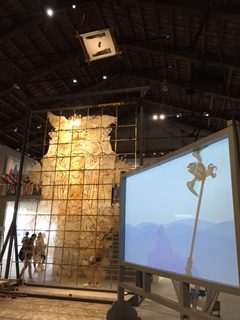
Another aspect I found a little bit unsettling in this exhibition is the attention to folk art as national representation. Already argued in the previous post, curator Qiu paid attention to the fluidity of culture, and acknowledged various foreign influences in contemporary Chinese art. However, his argument on 5000 years unbroken lineage of Chinese culture, reminds me of the advocacy by Meiji Kokugakusha about the unbroken lineage of royal family for cultural nationalistic propaganda. I appreciate Qiu’s inclusion of folk art into the cannon of contemporary art world, but use folk art in national pavilion, interpretating it as the essential of the national spirit is something I need to pause and think more about. Throughout history, the enthusiasm to folk art to explore the national spirit often went with cultural nationalism. The presence of national representative pavilions in Venice Biennale is already controversial enough, this year’s Chinese Pavilion’s even more focused contestation about the origin of Chinese culture is even more debatable against the background of the rise of nationalism in China in recent years (this is only my personal impression, with no verified studies). Moreover, the use of ancient mythologies from Sanhaijing as the origin of Chinese culture is another thing that concerns me in the exhibition. First of all, Sanhaijing is not a popular work in China; many people like me, heard of the stories, but are not familiar with them. The myths in Sanhaijing, an ancient book from about 300 BC, are high mythical and detached from real life. To my limited knowledge, the myths from the book received high praise from academia, but common people can hardly recognize any of their cultural influence in daily life. In general, the myths mentioned in the exhibition may actually seem foreign to many Chinese people. Furthermore, the exhibition is too sensational and thus becomes a spectacle. Visitors are overwhelmed by the visual impact of large installations and exotic culture of Chinese myths, which allows them no space to quietly think about the meaning behind the forms. Under the curatorial hand of Qiu Zhijie, there are many cultural references in the didactics that only limited group of people well educated in Chinese literature and art can understand. It is probably a tradition of ancient Chinese literati group to express their ideas more concisely, but become inaccessible for larger audience. One justification Qiu claimed for this inaccessibility is that he would like to do Chinese art in contemporary era, rather than contemporary art in China. With the emphasis on the authenticity of Chinese art, Qiu alienates art from common viewers of the Chinese public and international audience in Venice Biennale. For him, art plays in the realm of art, detached from real public life.
In general, like “Viva Arte Viva”, the idea advocated by Qiu Zhijie had many potentials, but through the curatorial practice, its meaning narrows down to the realm of pure aesthetics, and even to the dangerous zone of cultural nationalism.
“China’s Complicated Relationship with the Venice Biennale”, Tea Leaf Nation.
Koch, Franziska. “’China’ on Display for European Audiences? The Making of an Early Travelling Exhibition of Contemporary Chinese Art – China Avantgarde”, Berlin, 1993.
http://heiup.uni-heidelberg.de/journals/index.php/transcultural/article/view/9129/3103
Zhang, Tianyu & Liu, Qian. “Chinese Pavilion in Venice Biennale 2017, Collaboration of Contemporary Art and Intangible Cultural Heritage under Qiu Zhijie”. Artron, Opinions. * in Chinese
http://news.artron.net/20170207/n906155.html
Huang, Song. “Chinese Pavilion in Venice Biennale should Represent Chinese Spirit, Rather Than Merely Chinese Elements”. ThePaper, Opinions, Art Critic. * in Chinese
http://www.thepaper.cn/newsDetail_forward_1613604