Performance based art has been a reoccurring theme at the Venice Biennale and Documenta. In the Venice Biennale, we saw the Venice pavilion and the German pavilion. At Documenta we saw Documenta Halle and “Zero to Infinity” by Rasheed Araeen. The amount of communal spaces, manipulative art, and other forms of performance style art creates an interesting relationship between the work itself and the audience.
At the Venice Biennale, the Venice pavilion was full of very luxurious and expensive products. The work I would like to discuss at this pavilion is the ballroom dance footprints. The work requires two people to follow the steps. When two members of the audience engage this piece, they become the performers as the step diagram leads them into a waltz for the rest of the audience to enjoy. The diagram is shown below.

What I find interesting about this piece is how it begs the question of what is the art? Is it the diagram itself, the transition from audience member to performer, or the performers waltzing on the step diagram? This type of interactive art is could be called a relational object.
Another interactive pavilion we saw at the Venice Biennale was the German pavilion. The German pavilion, to me, was a social spectacle. The pavilion itself was set up with large cages with dogs on the outside, a glass floor a couple foot above the pavilion’s floor, and performers. The performers dominated the space. They would perform a tangled dance on the glass floor which resulted the audience to move out of their way and crowding around the performers. They would crawl under the glass floor and the audience would follow from above in hoards. The manipulation of the audience in this way seemed to put the audience on display as I found myself watching the audiences’ reactions more than the choreogr

Even though the performers dominated the space, they were dressed in a way in which one could not necessarily tell that they were a performer. This created an interesting dynamic between the audience and performers. This further speculated the audience as the performer could be one with the audience.
At Documenta, the Documenta Halle is an excellent example of a performance themed exhibition. The space was filled with musician archives, such as Ali Farka Toure, sound installations, such as the “Sound on Paper” work by Alvin Lucier, and a work entitled “Scene A L’Italienne” by Annie Vigier and Franck Apertet.
“Scene A L’Italienne”, is an intriguing work. The work itself could easily go unnoticed because it is a wooden ramp with stairs on one end, near a performance space. The work is particularly interesting because it prohibits event reservations. Instead it analyzes the spontaneous performance of how the audience interacts with the stage. Like the German Pavilion, this piece puts the audience on display. No matter how one reacts to the stage, they cannot escape being put on display by the work. Whether they walk around the stage, walk on the stage, or fall off the stage they are on constant display.

Another relational object found at Documenta was “Zero to Infinity” by Rasheed Araeen, that was seen in the Pavilion of the Commons at the Venice Biennale. This time they had been transformed into a table with books for the audience to read. This was very interesting to me. Unless one recognized the cubes shown below, to be a work by Rasheed Araeen, they would not necessarily know to look for the didactic or that they are interacting with an artwork. The use of this object as a table is a clever way to break down the normal barriers between art and audience.

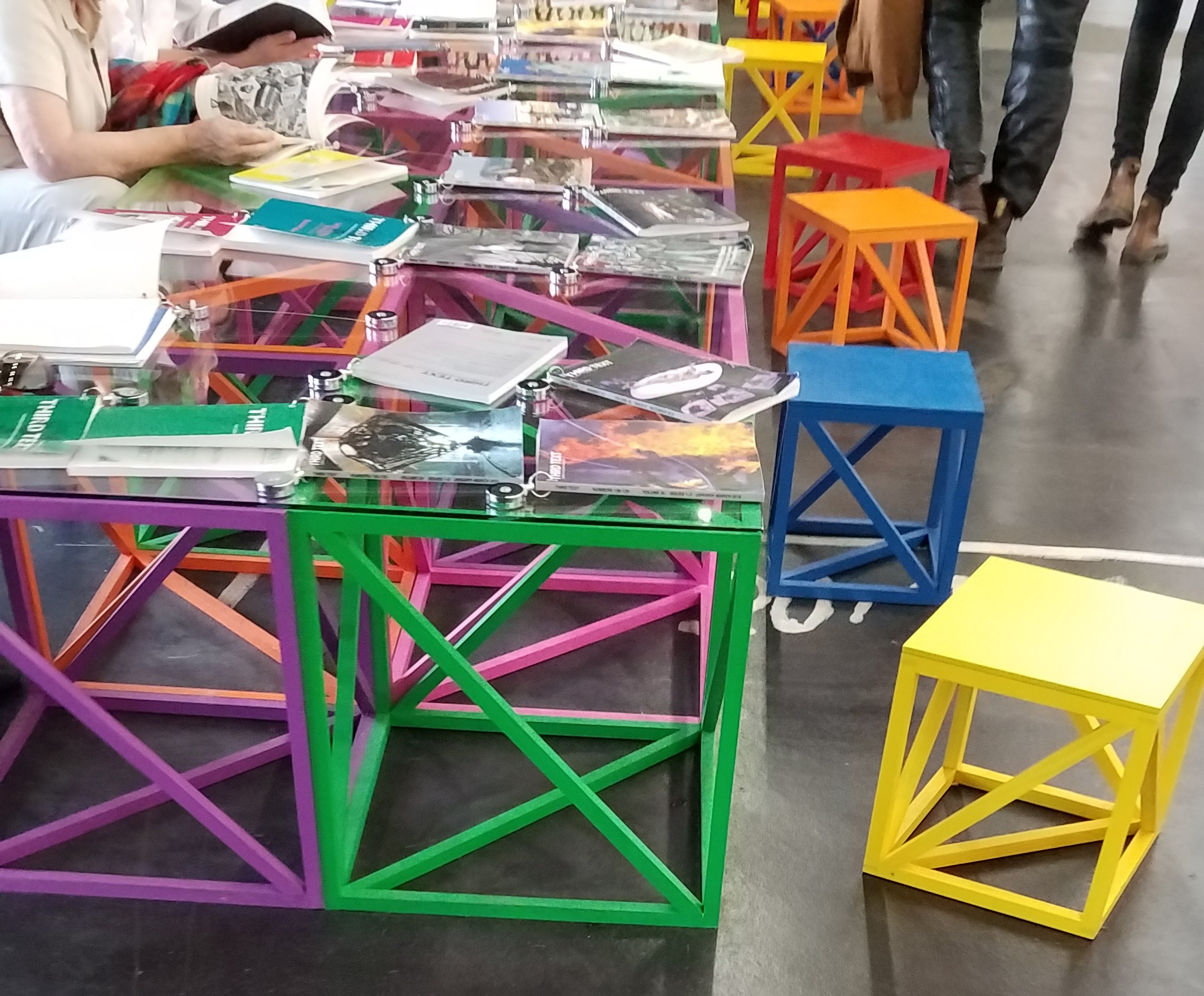
The idea reoccurring theme of relational objects and interactive art has shown itself at the Venice Biennale and Documenta 14. I find the idea of a break in traditional relationship between the audience and the work fascinating. It analyzes the traditional way to view art in a conservative space at arm’s length and offers a different experience.