Before I left for Spain in mid-July, I was advised to go inside any Gaudi place I came across while in Barcelona. The first day I was in Barcelona I did not understand what that meant but the next day I stumbled upon a Gaudi exhibition. At first the exhibition seemed to present Antoni Gaudi as a modern comic artist while I thought he owned a clothing line. After some reading and listening to the audio guide provided, I realized that he was an important Architect in Barcelona. Under the influence of neo-Gothic art and East-Asian techniques, Gaudi was part of the Catalan Modernism movement, developed organic style, and designed seven world heritage sites.
The World’s Fair began in Paris with the goal to advance the countries technology, industries, and agriculture. The 1888 World’s Fair in Barcelona, initiated the Catalan Modernism movement. Catalan Modernism was a movement away from the traditional Baroque and Gothic styles to move towards a more thought-provoking style. In architecture the style uses concrete, tiles, and iron in intriguing ways. Largely because of Gaudi, Catalan Modernism mimics shapes, lighting, and colors found in nature.
The Sagrada Familia is the most monumental piece Gaudi designed. The massive, eighteen tower cathedral remains incomplete to this day. The cathedral was massive regardless of not being complete. Staying less than thirty meters away from the Sagrada Familia makes it easy to navigate back to ones Airbnb no matter where they are. The cathedral is very central and upon completion in the late two-thousand and twenties planned to reach one-hundred seventy-two meters in height. The structure has three monumental facades to represent the birth of Christ, his death and resurrection, and his future glory. The spires are a gorgeous organic work that with balls and other eccentric features seen below.
Aside from Gaudi’s unique stylistic choices is his innovative choice to include an outdoor altar. Gaudi wanted the word of God to be heard by all and not only those who were able to get a seat inside of the massive cathedral. The altar was not the only work of Gaudi’s that was given to the community.
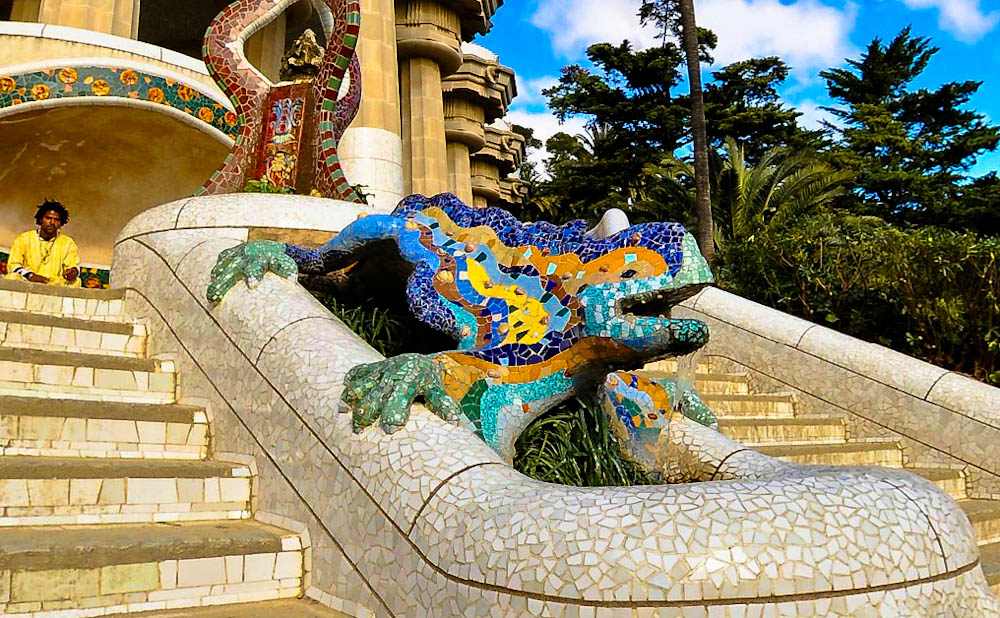
Although the Park Guell was not originally designed for the public, it is an amazing example of Catalan Modernism. The paths in the park are decorated in beautiful colored tile. The park is also the home of Gaudi’s famous “El Drac” salamander. The salamander is a multicolored mosaic emphasizing the influence that nature has on Gaudi.
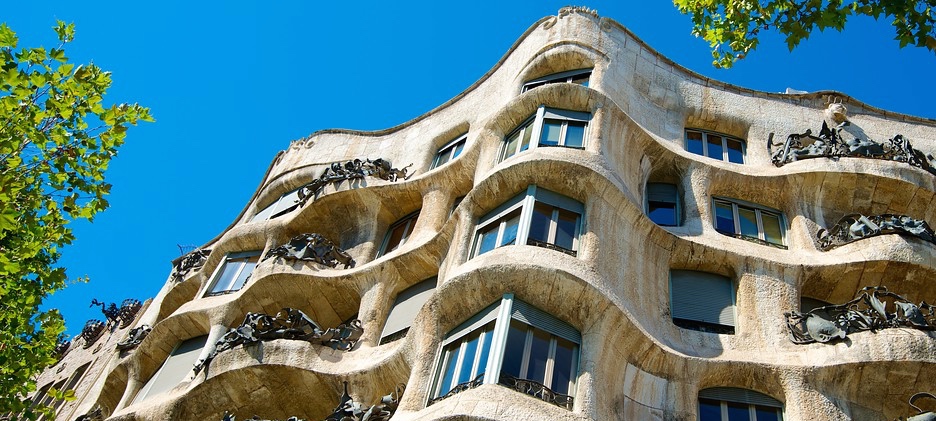
The Casa Mila was built in 1912. It’s a beautiful wavy building covered in limestone, marble, and glass. The wavy organic aesthetic contributes to the influence that nature had on Gaudi. The building has gone from apartments to a museum that and host for several different types of cultural events.
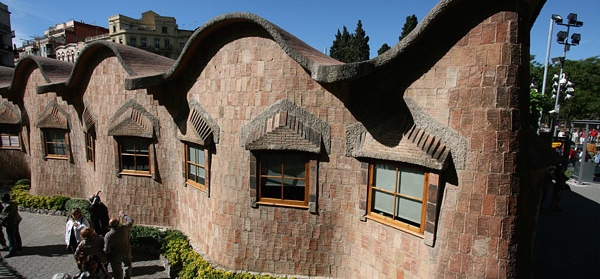
There is also the Sagrada Familia Schools which were built in 1909. These are also wavy in structure and covered in limestone. Again, the wavy aesthetic demonstrates the influence of nature on Gaudi’s work. They were built for the Sagrada Familia workers’ children. I have read that these will be removed before the Sagrada is finished to make space.
While I was listening to the audio guide, I learned that Gaudi also produced furniture. He produced benches that fit uniquely around columns out of leftover material, chairs using molds of the person who would be sitting in it so they would fit perfectly, and other intensively ergonomic designs. The image below shows a bench that was specifically designed to fit around a column.
Gaudi was a very resourceful person. He would create architectural models from the ceiling using string and weights. This made it possible for him to clearly express his ideas and plans in a way that speech could not.
Gaudi was worked with glassware, advancing technologies, mirrors, philosophical ideas, and more. I understand why Barcelona reveres Gaudi. He brought attention to the city, aided in bringing Catalan as a language back, and designed beautiful architecture that survives in various places around the city. Although I did not understand the Gaudi recommendation at first (I thought it was a clothing line), I would recommend taking the time to learn about Gaudi in Barcelona.